
Overview
Launched in 2023, the JICMAIL Response Rate Tracker contains aggregated anonymous campaign level data gathered from a variety of different organisations spanning sell-side businesses, agencies, data and technology partners.
Designed to complement JICMAIL’s ongoing panel measurement of consumer mail engagement, the Response Rate Tracker provides response, Return on Investment (ROI), Cost Per Acquisition (CPA), and Average Order Value (AOV) benchmarks for use in campaign target-setting and measurement.
At its core, the annually updated Response Rate Tracker supports three critical planning and measurement tasks. First, it enables benchmarking, allowing brands to assess campaign performance against sector and format norms. Second, it supports target setting, helping marketers build more accurate forecasts by grounding expectations in real campaign data. Third, it provides validation, enabling comparison between JICMAIL panel data and observed campaign outcomes.
For the latest Response Rate Tracker results, please go to Latest Response Rate Tracker
For a short explainer video on using the Response Rate Tracker, please go to Response Rate Tracker Explainer Video.
Background to the research
JICMAIL has been measuring how consumers interact with and respond to mail through its award winning panel since 2017. As a trusted, independent industry body responsible for promoting best practice planning and measurement in the mail channel, it was incumbent upon JICMAIL to develop new data streams that would enable planners and practitioners to validate JICMAIL’s core mail metrics while informing their own performance benchmarks.
With this in mind, JICMAIL embarked on a process of gathering mail campaign performance data directly from a handful of key industry players in order to generate a series of advertising mail response rate benchmarks.
The response rates measured employ a different methodology to JICMAIL’s panel based approach. Rather than relying on consumers to self-report how they have responded to a mail campaign, the Response Rate Tracker relies on mail practitioners to provide anonymous campaign-level data whose response rates will have been measured using matchback, unique-tracking code, or test and control techniques.
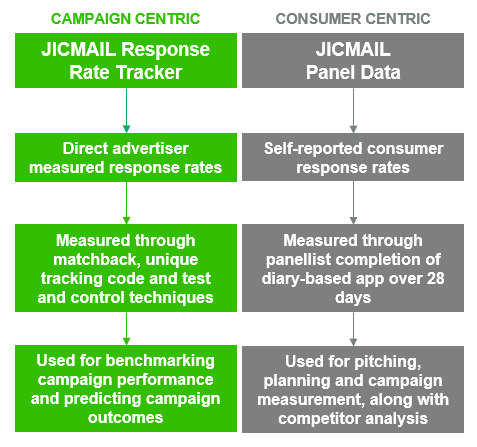
Consumer reported response data and advertiser tracked response data will naturally produce different results. However, by uniquely providing both sources of data to the mail community, JICMAIL hoped to provide greater clarity and transparency in mail measurement. This in turn would enable practitioners to triangulate in on the truth when measuring and benchmarking campaign performance.
Positioned as a pilot study, the first release of Response Rate Tracker data in 2023 was designed as a proof of concept from which the sample pool would grow and provide further granularity to the industry over time. We are pleased to say that each year since its launch, not only has the campaign pool increased but the updated tracker has progressively become a core part of the JICMAIL suite of datasets and tools.
The data collected
Contributors were asked to provide data reaching back to January 2021, in line with the following campaign criteria:
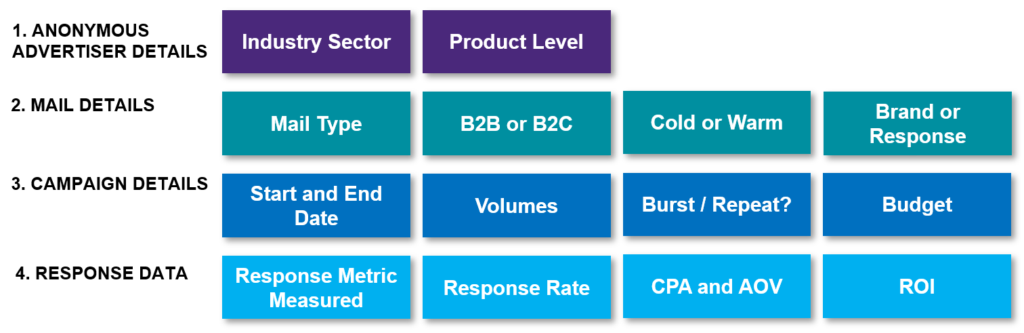
The benchmarks in the Response Rate Tracker are designed to give planners and marketers a robust set of data from which to set campaign targets, evaluate performance and measure campaign KPIs against. The very nature of benchmarks is that they create homogenous campaign averages from what are doubtless unique and nuanced campaigns.
It is for this reason that these benchmarks must be regarded as a guide to setting targets, rather than a de facto concrete number to which all campaigns must adhere. These benchmarks are a starting point for target setting: a starting point from which final targets will be iterated up or down by marketers based on a myriad of unique campaign, market and consumer factors.
What the Response Rate Tracker does do, is provide a robust and credible basis for this starting point.
Validating JICMAIL panel response rates
From the outset, we noted that for all Direct Mail (Warm and Cold), there is a strong alignment between the self-reported consumer centric panel data reported by JICMAIL and the campaign-centric data of the Response Rate Tracker – adding a weight of credibility to both measurement approaches and providing a useful validation of JICMAIL’s long standing panel metrics.
How to access the Response Rate Tracker
Response Rate Tracker data is available to all JICMAIL subscribers through JICMAIL Discovery
How to contribute campaigns to the Response Rate Tracker
JICMAIL welcomes submissions from further participants with a view to publishing an expanded set of benchmarks each year.
Please contact JICMAIL’s Director of Data Leadership and Learning, Ian Gibbs, using the contact form at the bottom of this page to register your interest.
Latest Response Rate Tracker Results
For an overview of:
– the most up to date list of participating organisations and
– our latest results and statistics